
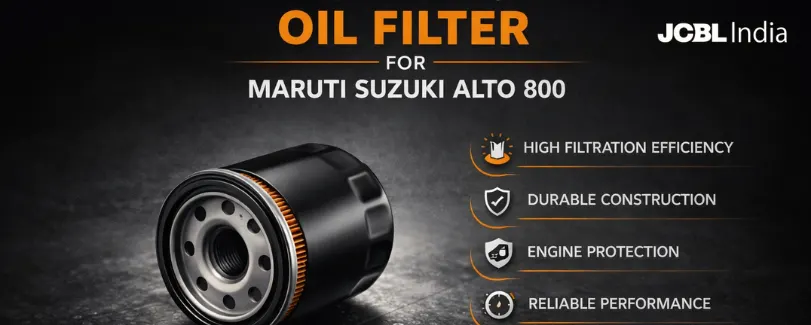
Superior Quality Oil Filter for Maruti Suzuki Alto 800 — JCBL India
The oil filter for Maruti Suzuki Alto 800 is a precision-engineered replacement component designed to maintain engine oil cleanliness, ensure stable lubrication, and protect critical engine components from wear and contamination. For importers and distributors, sourcing OEM-standard replacement oil filters is not merely a product purchase; it is a strategic procurement decision that impacts engine reliability, workshop satisfaction, and supply chain efficiency.
What Is an Oil Filter?
An oil filter is a mechanical device installed in the engine lubrication system that removes contaminants, debris, and microscopic particles from circulating engine oil. Engine oil can carry thousands of microscopic metal particles per operational cycle, making filtration efficiency critical. By capturing impurities, it maintains the oil’s viscosity and flow characteristics, which are critical for efficient lubrication of pistons, camshafts, bearings, and other moving components.
Oil filters are composed of:
- Filtration media: Cellulose, synthetic, or blend
- Housing: Corrosion-resistant metal casing
- Valves: Anti-drain back and bypass valves
- Seals and gaskets: Ensuring leak-free installation
Why is an Oil Filter Important for the Alto 800?
The Alto 800 is primarily a compact urban vehicle operating under stop-and-go traffic conditions, which stresses engine components due to frequent acceleration, deceleration, and idling cycles. An OEM-standard oil filter is crucial to:
- Prevent sludge accumulation and contaminant build-up
- Maintain consistent oil flow and pressure across engine components
- Reduce wear on crankshaft, camshaft, and bearings
- Support fuel efficiency and engine performance
- Ensure long-term durability under thermal and mechanical stress
For B2B buyers, choosing a reliable replacement oil filter is critical to avoid engine failures, workshop complaints, and high warranty costs.
Technical Parameters That Define OEM-Standard Oil Filter
To ensure reliable engine protection and consistent performance, OEM-standard oil filters are engineered with precise technical parameters that govern filtration efficiency, flow stability, and structural integrity.
- Filtration Media Quality
High-grade cellulose or synthetic media traps fine particles efficiently, maintaining engine oil purity while providing thermal and pressure stability under rigorous urban driving conditions.
- Oil Flow Rate and Pressure Stability
Balanced flow resistance ensures consistent lubrication across all engine components, preventing oil starvation during cold starts, high load, or variable driving conditions.
- Anti-Drain Back and Bypass Valve Performance
Anti-drain back and bypass valves maintain oil flow during startup or clogging events, while durable silicone or rubber components resist deformation and ensure reliable long-term performance.
- Structural Integrity and Housing Strength
Corrosion-resistant casing, precision threading, and high-quality gaskets ensure leak-free installation, robust mechanical stability, and consistent fitment, reducing workshop errors and operational downtime.
OEM-standard oil filters integrate superior media, precise flow control, reliable valves, and strong housing to maximize engine efficiency, durability, and performance in demanding operational environments.
The difference between an OEM-standard oil filter and a low-quality alternative becomes clearer when key technical parameters are compared side by side:
| Parameter | OEM-Standard Filter | Low-Quality Filter |
| Media | High-grade cellulose/synthetic | Low-density paper |
| Flow Stability | Controlled | Irregular |
| Valve Durability | Silicone-based | Low-grade rubber |
For importers and distributors, these differences directly influence engine reliability, warranty exposure, and long-term procurement stability.
Why Batch Consistency Matters in Bulk Procurement
For importers and distributors, single-unit quality is insufficient, as they buy orders in bulk; thus, batch-wide consistency helps them determine operational reliability. Key benefits of batch consistency include the following:
- Uniform filtration efficiency across all units in a shipment
- Predictable installation outcomes for workshops
- Reduced warranty claims and returns
- Stable engine protection performance across multiple vehicles
Consistent batches improve distributor credibility, simplify inventory management, and reduce logistical challenges in high-volume procurement cycles.
OEM Mapping & Cross-Reference Accuracy
Accurate OEM mapping ensures correct fitment and prevents misidentification, which is critical for bulk procurement. The oil filter for Alto 800 is compatible with:
- Reference Numbers: 16510M68K20 / 16510M65L10
- JCBL Part Number: JCMS-4129
Benefits of accurate OEM cross-referencing:
- Correct vehicle compatibility verification
- Streamlined inventory management
- Reduced procurement errors and misfitment risks
- Efficient warehouse operations and bulk order processing
Structured OEM mapping supports distributors in maintaining service reliability and supply chain precision.
Why Importers Source Replacement Car Parts from India
India has emerged as a globally trusted hub for automotive components. Key reasons for sourcing replacement parts from India include:
- Established Industrial Ecosystem: Organized clusters with modern machining, casting, and quality control facilities
- Process-Driven Production Culture: Systematic inspections, dimensional validation, and metallurgical testing
- Compliance with International Standards: ISO-aligned quality systems for export-readiness
- Scalable Production Capacity: Ability to meet medium- to high-volume bulk orders
- Cost-to-Quality Advantage: Competitive pricing without compromising technical specifications
These factors make India an attractive destination for importers seeking high-quality replacement car parts with OEM-standard reliability.
Why Choose JCBL India for Oil Filters?
As part of the JCBL Group, with over three decades of engineering and manufacturing expertise, JCBL India serves as a trusted B2B supplier of OEM-spec replacement oil filters for Maruti Suzuki Alto 800. The group operates state-of-the-art facilities spanning 167,000 sqm across five plants in Chandigarh and Chennai, ensuring large-scale production without compromising quality or precision.
Key advantages of choosing JCBL India include:
- OEM-Spec Replacement Parts: Developed to adhere to OEM specifications and quality standards (not original OEM components)
- Bulk Procurement Support: Organized B2B inquiry coordination with structured documentation
- Batch Consistency Assurance: Uniform quality and performance across all shipments
- Clear OEM Mapping: Reduces inventory errors, misfitment, and logistical challenges
- Reliable Supply Coordination: Supports distributors and importers in structured procurement cycles
Leveraging the JCBL Group’s advanced manufacturing ecosystem and legacy of engineering validation, JCBL India ensures batch reliability, operational consistency, and long-term B2B partnerships, providing importers and distributors with predictable, high-quality replacement car parts.
Conclusion
The oil filter for Maruti Suzuki Alto 800 (Reference No.: 16510M68K20 / 16510M65L10 | JCBL Part No.: JCMS-4129) is a crucial replacement component for ensuring engine longevity, consistent oil flow, and overall vehicle reliability.
For importers and distributors, selecting OEM-spec replacement parts is a strategic procurement decision that reduces operational risks, supports workshop efficiency, and guarantees batch-wide performance.
Coordinate directly with JCBL India for OEM-spec oil filters and structured B2B supply solutions in bulk.
FAQs
How often should the oil filter for Alto 800 be replaced?
Typically, every 10,000–15,000 km or as per the vehicle maintenance schedule. Regular replacement ensures consistent engine protection and lubrication.
Can OEM-spec replacement oil filters perform like original parts?
Yes. Replacement filters developed to OEM specifications provide reliable engine protection, consistent oil flow, and durable performance comparable to original components.
What happens if a low-quality oil filter is used?
Substandard filters may collapse, clog, or allow contaminants through, causing engine wear, reduced efficiency, and potential component failure.
Why is batch consistency important for importers?
Uniform batch performance ensures predictable installation, reduces warranty claims, and maintains the reliability of engine protection across bulk shipments.
How does JCBL India support B2B procurement of oil filters?
By providing OEM-spec replacement parts, structured documentation, OEM mapping clarity, shipment-wide batch consistency, and organized bulk order coordination.